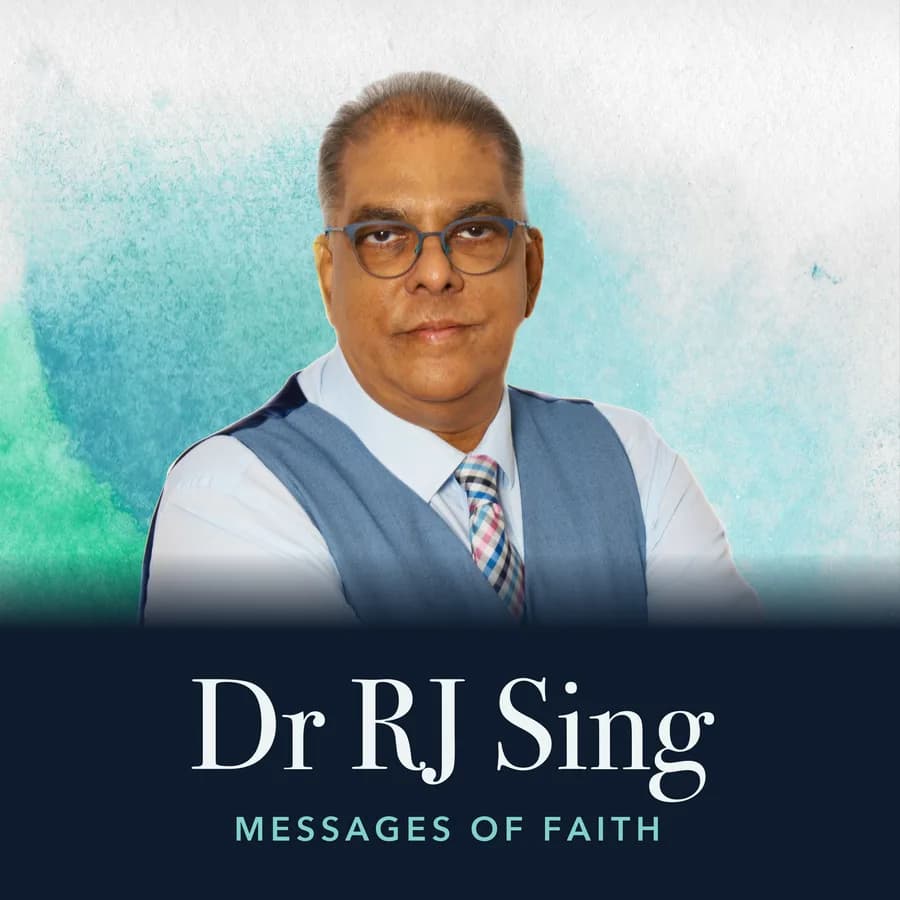
Put Your Faith on the Line: Do Not Grow Weary or Lose Heart
Dr RJ Sing, 30 min, Part 7 of What Faith Is
Originally recorded as “What Faith Is, Part 7”
Sermon outline
Jesus is the developer of your faith, and he develops it when you put it on the line: put the Word first, meditate on it, act on it and speak it, and do not grow weary while you wait.
Main text
- Mark 11:23-24
- Hebrews 12:1-3
Opening
He welcomes the congregation and everyone else watching and says, 'we're back on our teaching' and 'we will continue our subject on faith'. He reads Mark 11:23-24 again as the foundational scripture he used 'at the beginning of the lessons on faith', calling these lessons the fundamentals of faith, and repeats that the Bible is not a book to help you endure but a book about doing business with both God and man. He announces the morning's subject, developing faith, and asks viewers to turn to Hebrews 12:1-3.
The men and women he learned faith from
While viewers find Hebrews 12 he acknowledges his teachers. He learned faith from the late Kenneth Hagin, and prosperity from Kenneth and Gloria Copeland and Dr Fred Price. He also names Jesse Duplantis, Jerry Savelle and Creflo Dollar as men he admires and says he developed his faith by listening to them.
Illustration: Years ago, while he was away at university on a course, robbers broke into his home and tied up his helper and his son Adrian, who was about ten and home sick from school. Adrian told them, 'you can steal anything, but don't steal these tapes. These are my dad's treasure trove.' They took his video tapes of those preachers anyway. His response was to thank God that his family was safe and to hope that whoever played the tapes would get saved.
“I am a total of parts of many men and women of God who have influenced me in my life.”
Developing faith: do not grow weary and lose heart
He reads Hebrews 12:1-3: run the race with perseverance, fixing your eyes on Jesus, the pioneer and perfecter of our faith. Every country, government, leader and ordinary person is being challenged, and it is easy to grow weary, but he calls not losing heart an instruction from God. Receive Jesus as the developer of your faith: when your faith is on the line, he will help you develop it.
“Today may be painful, but pain must pass.”
- Hebrews 12:1-3
1. Put the Word of God first
His first point on putting your faith on the line, which he says he learned from other men of God: whatever happens, go back to the Word of God, because it teaches man how to transact with God and with his fellow men.
Illustration: Every electronic device comes with a manual. Someone said the earth did not come with one; he answers that it has, and the manual is the Word of God.
“The word of God has got the answers for everything in life.”
2. Meditate on the Word of God
Putting the Word first and meditating on it builds a capacity for faith. Time spent with the Word enlarges what you are able to believe.
“When you spend time with the word of God, it builds a capacity for faith.”
4. Begin to act on the Word of God
Do not be a hearer only but a doer: practise whatever you hear and read, because doing what God asks is what puts your faith on the line. Faith begins to grow when the Word becomes a vital part of your daily conduct and your daily speech, and as it grows Satan's dominion wanes and adverse circumstances lose their grip on your life.
Illustration: His own language and thinking changed over the years. On a long-haul flight, while he was meditating on the Word, the Spirit of God told him to write a book on the language of the new man, setting out how believers should speak.
“By practicing it, you are actually putting your faith on the line.”
- James 1:22
- Matthew 12:34
Decide two very important things
He repeats what he has mentioned before: number one, decide to live by faith, and second, decide to live the love life. These are two things you decide and then practise. If you do not walk in love, your faith is not strong and fails to function.
“Your faith fails to function because faith works by love.”
- Galatians 5:6
The spirit of faith: what does faith say?
'I believed, therefore I have spoken': since we have the same spirit of faith, we also believe and therefore speak. Faith calls things that be not as though they were, and the righteousness that is by faith says that the word is near you, in your mouth and in your heart.
“Faith calls those things that be not as though they were.”
- 2 Corinthians 4:13
- Romans 4:16-25
- Romans 10:6-8
Jesus used God's way of dominion
God's plan is for man to have dominion over his environment, so we are not shifted, moved and swayed by circumstances; our heart is fixed on the Word. Jesus exercised dominion by speaking: to the man with leprosy, 'I'm willing' and 'be clean'; to the fig tree; and of Lazarus, that the sickness would not end in death and that he was going there to wake him. He was emphatic and sure because his confidence was in God and in the Word of God.
Illustration: The man with leprosy who begged on his knees, 'If you are willing, you can make me clean.' Many people do not know whether God is willing to help them; Jesus settled it.
“A thousand times, yes. God is willing and he's able.”
- Mark 1:40-42
- Mark 11:14
- John 11:1-11
Abraham's faith
Abraham gave God glory by calling things that be not as though they were. God chose the weak and lowly things, and he chose us when we were lost and walking in darkness. Abraham faced the fact that his body was as good as dead and did not waver, being fully persuaded that God had power to do what he had promised. We usually turn to man and to natural answers, and there is nothing wrong with that, but there is a higher power than the natural.
Illustration: On the way to sacrifice his son, Abraham told his servants, 'the lad and I will go yonder and we'll come back to you again.' He was speaking words of faith. Zechariah, by contrast, asked the angel, 'How can I be sure of this?'
“God has the power to do what He has promised us.”
- 1 Corinthians 1:27-28
- Romans 4:19-21
- Luke 1:18
- Genesis 22:5
Take it step by step
The first thing is to go to the Word of God that covers the situation. The second is to keep it before your eyes, your ears and your mouth. The third is to go to God on the basis of his provision and not on your needs. Then speak to the mountain and you will see the end results, as David did when he told Goliath what he was about to do.
Illustration: David announcing to the Philistine, 'This day the Lord will deliver you into my hands.' What he said, he accomplished.
“Now remember he was saying all of this before he had actually done it.”
- 1 Samuel 17:45-46
Putting it into practice
- Do not grow weary or lose heart; today's pain will pass.
- Put the Word first, meditate on it, and practise what you hear.
- Let the Word change your daily conduct and your daily speech.
- Decide to live by faith and to live the love life.
- Go to God on the basis of his provision, and speak to your mountain before you see the result.
Closing
He returns to where he began: do not become weary and do not lose hope. He asks viewers to lay a hand on the chest, touch someone beside them or touch the television screen as a point of contact, then binds sickness and the spirits that bring poverty, prays that spiritual eyes will be opened to see that Jesus is Lord, and thanks God that every financial and physical need is met. He tells viewers they are important in the economy of God, uniquely created and chosen, and urges them to let God be their physician, banker, counsellor and friend. He ends with a word of hope for young people and says they will meet next week.
In his words
- “Today may be painful, but pain must pass.”
- “The word of God has got the answers for everything in life.”
- “When faith begins to grow, Satan's dominion begins to wane.”
- “A thousand times, yes. God is willing and he's able.”
- “Let him be your physician. Let him be your banker. Let him be your counselor. Let him be your friend.”
Every scripture in this message
- Mark 11:23-24
- Hebrews 12:1-3
- James 1:22
- Matthew 12:34
- Galatians 5:6
- 2 Corinthians 4:13
- Romans 4:16-25
- Romans 10:6-8
- Mark 1:40-42
- Mark 11:14
- John 11:1-11
- 1 Corinthians 1:27-28
- Romans 4:19-21
- Luke 1:18
- Genesis 22:5
- 1 Samuel 17:45-46